Building Credit With Bank of America: Student, Secured and Starter Cards
How the issuer's entry level products differ, what each one is actually for, and how to use a first card so it builds history rather than debt
The Answer First
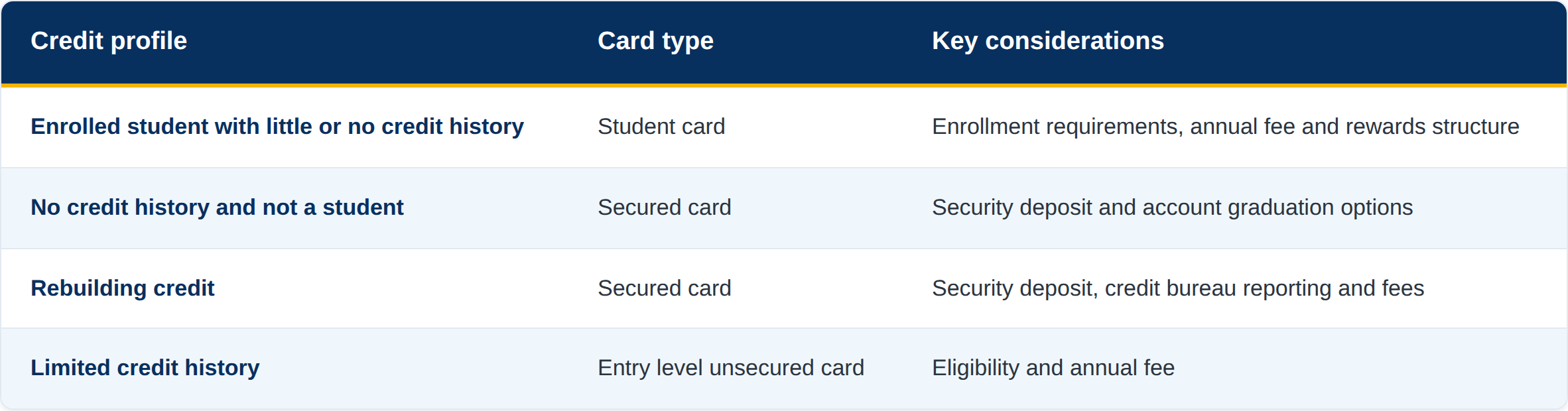
Bank of America offers entry level cards for different starting points, including student cards such as the Bank of America® Customized Cash Rewards credit card for Students. Secured cards can also be an option for those establishing or rebuilding credit history with a refundable deposit. The product matters less than how you use it. Paying the statement balance in full each month and keeping utilization low are what build credit history.
How Credit Cards Help Build Credit
It is worth being direct about this before comparing products. Credit history builds through on time payments and low utilization over time. No entry level card builds credit faster than another because of its rewards structure. What the card choice affects is whether you are likely to be approved, whether it costs you anything to hold, and whether the habits it encourages are good ones.
That reframes the comparison usefully. The best first card is the one you can be approved for, can hold without a fee, and can pay in full every month.
How Does a Secured Credit Card Deposit Work?
A Security Deposit Is Collateral, Not a Fee
A secured card requires a refundable security deposit that generally establishes the credit line. The deposit is not a charge and is not spent on purchases. It is held by the issuer and returned when the account is closed in good standing or the account transitions to an unsecured product, subject to the issuer's terms.
Do Secured Credit Cards Report to Credit Bureaus?
The point of a secured card is that it reports to the credit bureaus the same way an unsecured card does. That is the mechanism by which it builds history. A card that does not report does not build credit, so confirm reporting before applying.
When Do You Get Your Secured Card Deposit Back?
Ask what the path looks like for the deposit to be returned and whether the account can transition to an unsecured product while keeping its history. An account that has to be closed and reopened loses the age you spent time accumulating.
What to Look for in a Student Credit Card
Look for a Student Card With No Annual Fee
A first card should not cost money to hold. Entry level student products generally carry no annual fee, and a fee on a first card is a reason to look elsewhere.
Consider a Simple Rewards Structure
A first card's purpose is to establish history. A complicated category structure invites spending optimization at a stage when the useful habit is spending less than you earn and paying in full. Simplicity is a feature.
Do You Have to Be a Student to Get a Student Card?
Student products generally require enrollment in an eligible institution. Confirm the requirement and what documentation is needed before applying, and ask what happens to the account after graduation.
How to Use Your First Credit Card to Build Credit
- Put one small recurring charge on it. A single predictable subscription is enough. The account needs activity to report, not volume.
- Set up automatic payment of the statement balance in full. Paying the full statement balance avoids interest. Paying only the minimum does not.
- Keep utilization low. Utilization is the share of your credit line in use. The CFPB notes that keeping it low is generally favorable. On a small starter line, even modest spending can push it high, which is an argument for keeping the recurring charge small.
- Do not close it once you move on. Account age contributes to history. A no fee first card can usually stay open quietly after you have better products.
- Check your reports. Confirm the account is reporting as expected and that the information is accurate.
Credit Building Mistakes to Avoid
The two common failures are carrying a balance because the minimum payment feels like the bill, and opening several accounts quickly in the belief that more credit builds faster.
Neither helps. Interest on a starter card is expensive, and rapid applications create inquiries and new accounts that work against a thin file. One card, used quietly and paid in full, does the job.
When to Consider Moving On From a Starter Card
There is no fixed timeline, and any specific period you read should be treated as a generalisation rather than a rule. The signals worth watching are a consistent on time payment record, a credit line that has grown, and a score range that opens up products you could not previously access.
At that point, ask the issuer which product changes are available on the account before applying for something new. A product change can preserve the account and its history without a new application, though it generally will not earn a new card welcome offer.
Frequently Asked Questions
The Bottom Line
Choose the entry level product you can be approved for and hold without a fee, then let time and consistency do the work. A secured card's deposit is collateral and refundable; a student card's value is simplicity. Put one small recurring charge on the account, pay the statement balance in full automatically, keep utilization low, and leave the account open once you have moved on.
Choose Your Next Step
- Compare Bank of America student credit cards
- See secured credit cards
- Compare cards with no annual fee
Sources
- CFPB What is a secured credit card?
- CFPB What is a credit utilization rate?
- CFPB Building credit from scratch
- Bank of America BofA Rewards program overview and tiers
As Seen In





Trust & Secure