When you choose a credit card, you're also choosing the institution standing behind it – its stability, its reach, and its staying power. Bank of America is one of the “Big Four” U.S. banks, alongside JPMorgan Chase, Wells Fargo, and Citigroup, and by most measures it ranks as the second-largest bank in the country.
Where Bank of America ranks among the largest U.S. banks
In the Federal Reserve's ranking of U.S. domestically chartered commercial banks, based on data as of December 31, 2025, Bank of America holds the number-two position by consolidated assets – behind only JPMorgan Chase and ahead of Citibank and Wells Fargo:
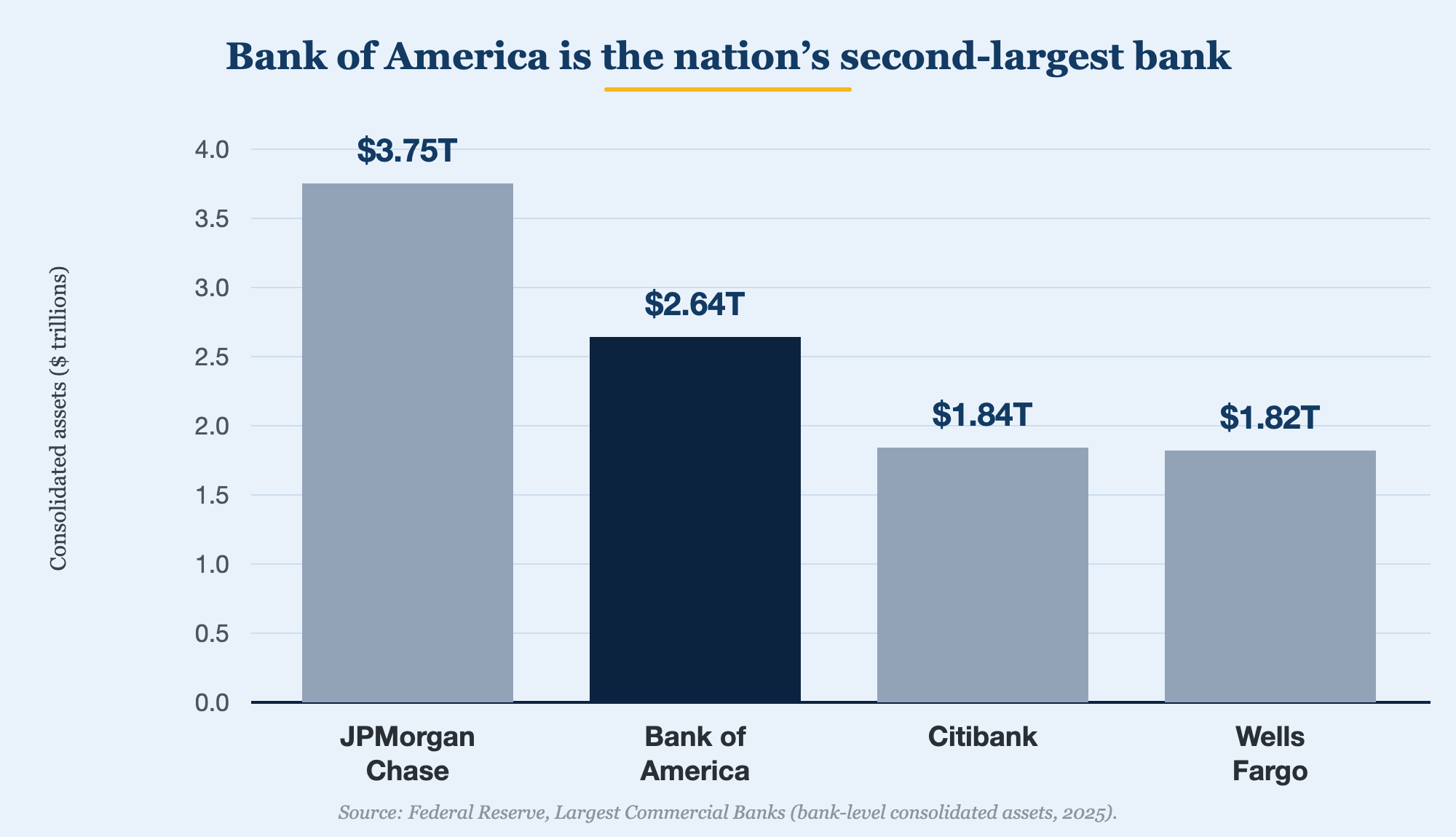
Bank of America ranks second among U.S. commercial banks by consolidated assets. Source: Federal Reserve.
At the parent-company level, Bank of America reported roughly $3.4 trillion in average total assets in 2025 – a scale that places it among the world's largest financial institutions. As a U.S. global systemically important bank, or G-SIB, Bank of America is also subject to heightened capital and regulatory requirements.
How Bank of America got this big
Today's Bank of America is the product of two major eras of dealmaking. The modern company took shape in 1998, when NationsBank and BankAmerica merged, with the combined company headquartered in Charlotte, North Carolina. A decade later, during the 2008–09 financial crisis, Bank of America acquired Countrywide Financial and Merrill Lynch – transformative deals that significantly expanded its mortgage and wealth management businesses. (For the earlier history, from A.P. Giannini's 1904 Bank of Italy to the launch of BankAmericard, see the companion history article.)
Two eras of dealmaking – the 1998 NationsBank merger and the 2008–09 crisis acquisitions – built the bank we know today.
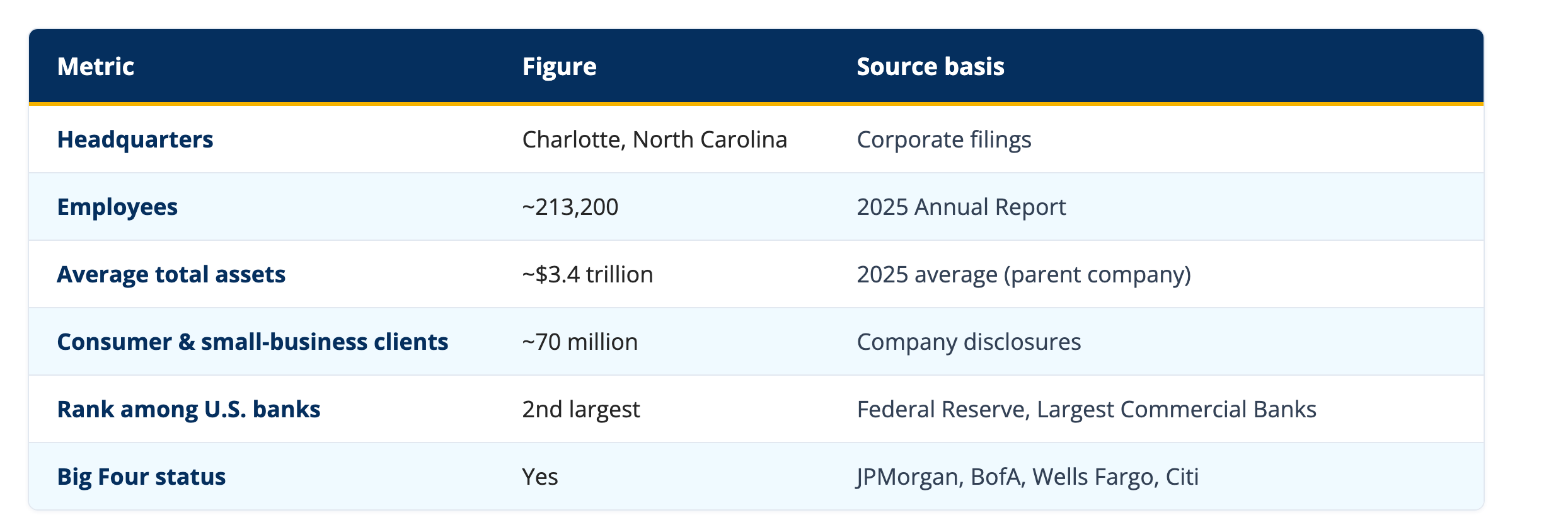
Bank of America at a glance
Here are some of the figures that defined the company's scale at the end of 2025:
Why financial strength matters to a cardholder
Size isn't everything, but for a card issuer it carries real advantages: the resources to weather downturns, invest in technology and serve customers across major U.S. markets. Bank of America, for example, has invested heavily in digital banking and its AI-driven virtual financial assistant, Erica®, which surpassed 3 billion client interactions in 2025.
As one of the largest and most closely regulated banks in the country, Bank of America has the scale and resources of an institution built for long-term financial relationships.
That's context, not a recommendation. The right card still comes down to the specific terms, rewards, and fit for how you spend – but knowing the size and strength of the institution behind it is a reasonable part of the picture.
EXPLORE BANK OF AMERICA ON COMPARECREDIT
→ See Bank of America's current credit card lineup
→ Everyday cash-back and rewards programs
→ Travel and premium card programs
→ Cards for small businesses
Sources
Bank of America, 2025 Annual Report (Form 10-K) – total and average assets, employee count, client figures, financial centers, digital users and headquarters. U.S. Securities and Exchange Commission (SEC.gov).
Federal Reserve, U.S. Domestically Chartered Commercial Banks, data as of December 31, 2025 – ranking and consolidated assets of U.S. commercial banks. federalreserve.gov.
Federal Reserve, Large Bank Capital Requirements, August 2025 – Bank of America capital requirements and G-SIB surcharge. federalreserve.gov.
Bank of America and SEC historical filings – 1998 NationsBank–BankAmerica merger; 2008 Countrywide acquisition; 2009 Merrill Lynch acquisition.
Bank of America Newsroom – Erica® usage and digital banking figures.