Pairing Bank of America Cards: How a Two Card Setup Works
The Answer First
A two card setup pairs a category card with a flat rate card so that eligible category spending can earn an elevated rate up to its cap while other spending earns a consistent flat rate. For Bank of America cardholders, this could mean pairing the Bank of America Customized Cash Rewards credit card with the Bank of America Unlimited Cash Rewards credit card.
Where a Single Card Falls Short
Every rewards structure has a shape, and every shape leaves something uncovered. A category card pays well on a slice of spending and drops to a base rate on the rest, or once it hits a cap. A flat rate card pays the same on everything, including the categories where a category card would have paid more.
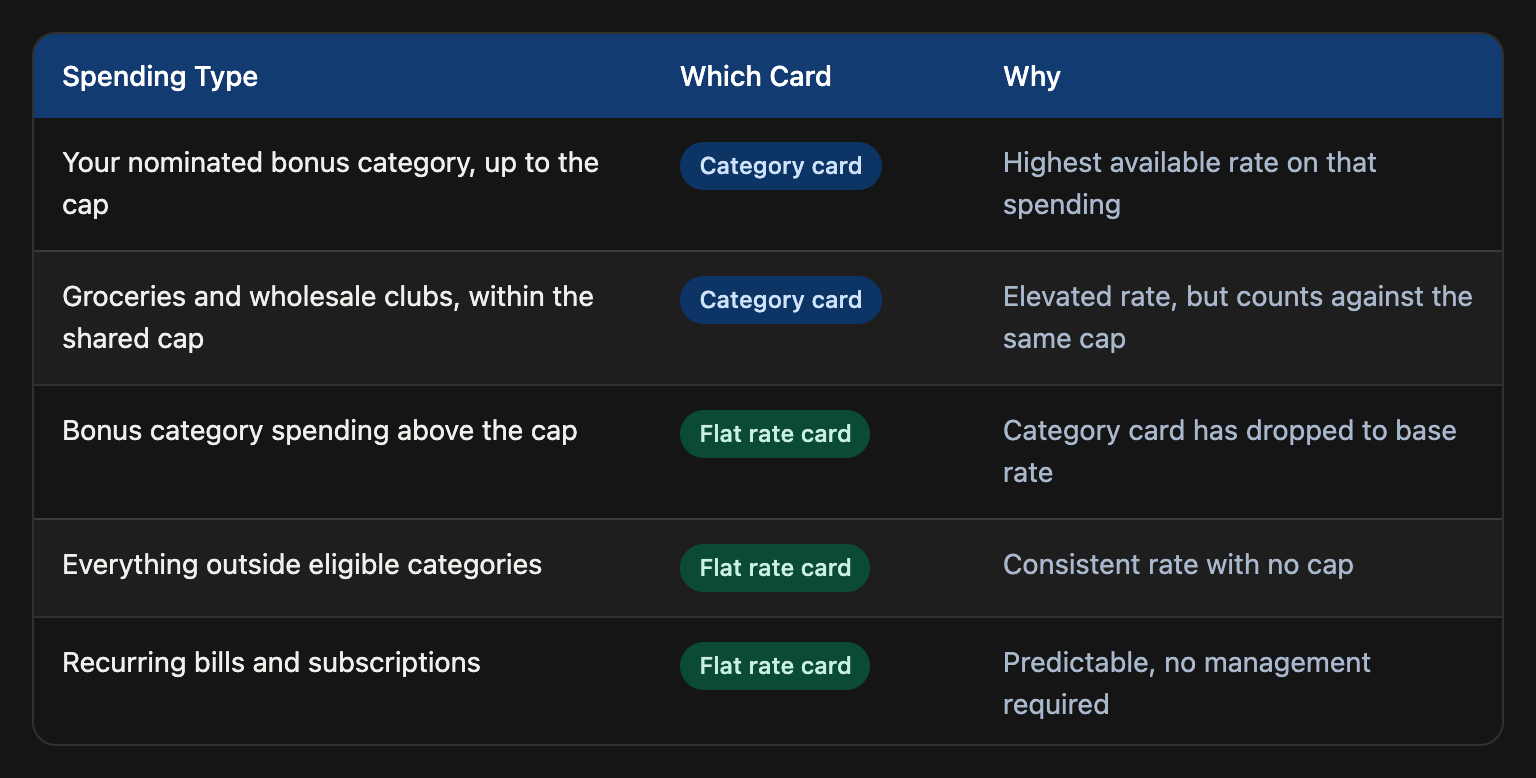
Holding one of each closes most of that gap. The category card takes the nominated category up to its cap; the flat rate card takes everything else, including spending above the cap. Because both cards have no annual fee, there is no annual fee cost associated with holding both.
When a Second Card May Make Sense
Your bonus category spending exceeds the cap
This is the clearest case. If you regularly spend past the cap, that overflow is earning a base rate on a card built for something else. A flat rate card catches it at a better rate with no management.
A meaningful share of spending sits outside every eligible category
If a large part of your statement falls outside the categories the issuer offers, a flat rate card covers it more efficiently than the base rate on a category card.
You Will Actually Route Purchases
The structure only returns more if the right card is used for the right purchase. If you will reach for whichever card is nearest, a single flat rate card returns more than a badly used pair.
When a Second Card May Not Make Sense
A second card may not make sense if it could lead to carrying a balance, since interest charges can outweigh additional rewards.
It may also make sense to avoid adding a card solely for a welcome offer if meeting the requirement would require additional spending.
Consumers who are early in building credit history may also prefer to focus on managing an existing account before adding another.
How BofA Rewards™ Affects a Two Card Setup
The issuer's relationship multiplier applies to eligible cards' base earning. In a paired setup it lifts both cards, which means the tier improves the whole structure rather than favoring one card over the other.
- The multiplier does not raise the category cap, so the overflow logic that motivates the pairing is unchanged at any tier.
- A higher tier increases the value of the flat rate card's coverage as well as the category card's, so it is not an argument for consolidating onto one card.
- Confirm that both products are eligible under the program; the issuer maintains a list of ineligible cards.
How to Manage Two Cards Without the Hassle
- Assign each card a fixed job. Write it down. The category card is for the nominated category; the flat card is for everything else.
- Put recurring charges on the flat card. Subscriptions and bills should sit where they need no thought and no category management.
- Set both to automatic full statement payment. This is the step that protects the whole structure.
- Review the nominated category twice a year. Not monthly. Enough to catch a genuine change in your spending, not so often that it becomes a chore.
- Track the cap loosely. You do not need exact figures. Knowing roughly when in the quarter you tend to cross the cap is enough to switch cards at the right time.
Should You Add a Third Card?
A third card may make sense when it covers a genuinely different need, such as travel benefits for someone who travels frequently or separation of business spending. Adding a third card with an overlapping structure adds management burden without adding coverage.
Applications also have consequences. Each one creates an inquiry and, if approved, a new account. Before applying, ask the issuer which product changes are available on your existing accounts, since a product change can sometimes deliver the structure you want without a new application.
Frequently Asked Questions
Does holding two cards from one issuer hurt my credit?
Each new application generally creates a hard inquiry and, if approved, a new account. The effect depends on your overall profile.
Do both cards need to be no annual fee?
Not necessarily, but the structure is easiest to justify when neither card costs anything to hold. A fee on either card means the pairing has to recover that cost before it returns value.
Does the shared quarterly cap apply across both cards?
Caps are generally applied per account rather than across a cardholder's whole relationship, but this is issuer defined. Confirm before assuming the pairing doubles any allowance.
Which card should recurring bills go on?
The flat rate card, unless a bill falls into your nominated category and you have cap room. Recurring charges are best placed where they need no ongoing management.
Can I get a second card through a product change instead of applying?
A product change moves an existing account to a different product rather than adding a second account, so it will not create a pair. Adding a card requires an application.
Is three cards better than two?
Only if the third covers a need the first two do not, such as travel benefits or business spending separation. Overlapping structures add work without adding coverage.
The Bottom Line
A two card setup can give each card a defined role. The Bank of America® Customized Cash Rewards credit card can be used for eligible category spending up to its cap, while the Bank of America® Unlimited Cash Rewards credit card can provide a consistent flat rate for other purchases. The approach works best when the added account does not lead to unnecessary spending or carrying a balance.
Choose your next step:
Compare Bank of America credit cards
See Bank of America cash rewards cards
Compare cards with no annual fee
Sources
● Bank of America BofA Rewards program overview and tiers
As Seen In





Trust & Secure