Most credit card statistics are backward-looking. Bank of America is one of the few issuers positioned to see spending as it happens: through its Bank of America Institute, the bank publishes a monthly Consumer Checkpoint that aggregates anonymized card and deposit activity from tens of millions of households. Read alongside the Federal Reserve's quarterly debt data, it offers a rare two-lens view — the real-time pulse of spending, and the slower-moving picture of what households owe.
The real-time read: spending is accelerating
Bank of America's internal data shows household card spending picking up speed through early 2026. Total card spend per household rose 2.6% year over year in January, 3.2% in February, and 4.3% in March — the strongest reading in roughly three years. The bank attributes part of the lift to larger tax refunds flowing to households, which tend to boost discretionary categories.
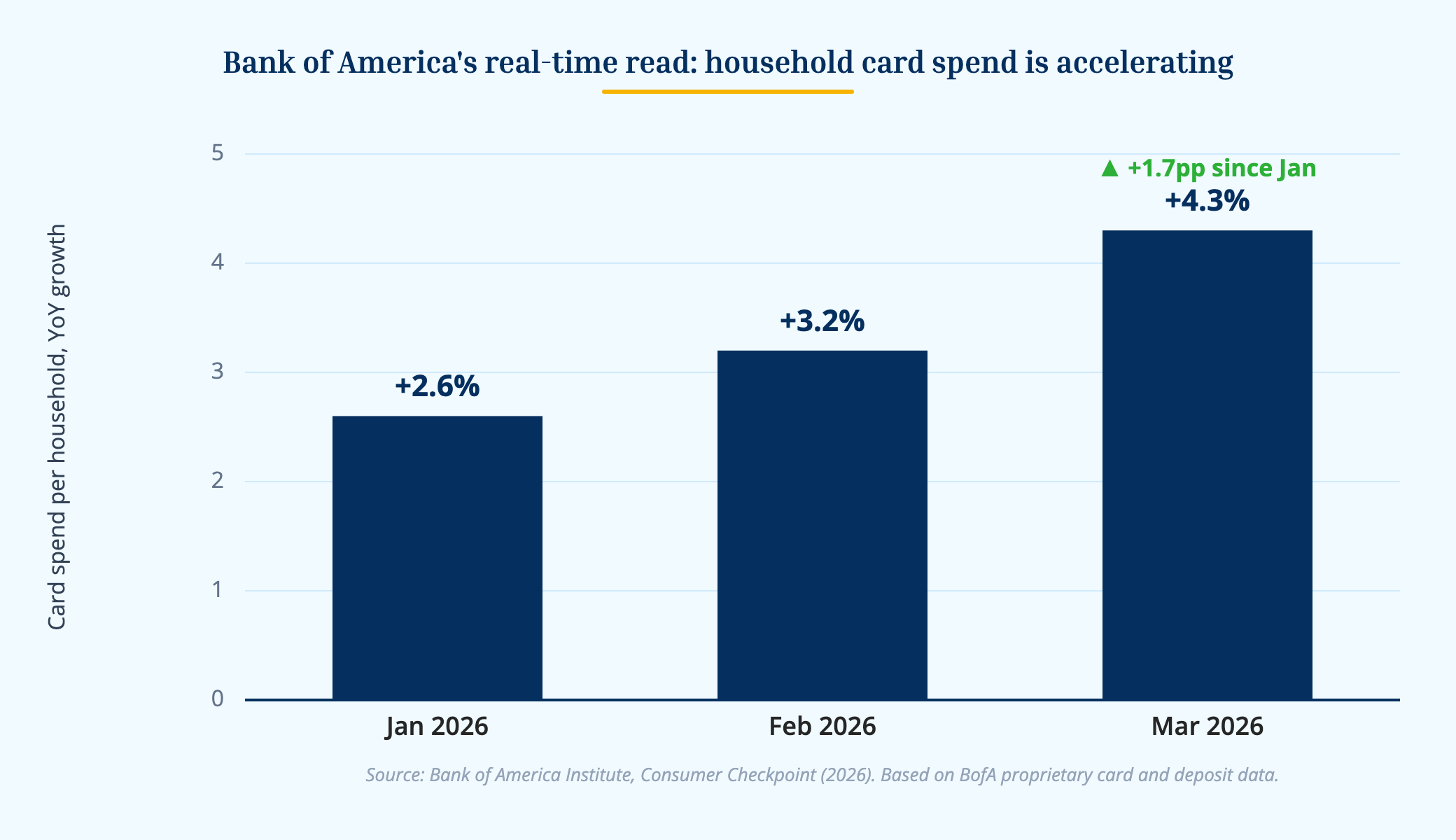
Year-over-year growth in card spend per household, from Bank of America's proprietary Consumer Checkpoint.
The bank also flags a persistent “K-shape” in the data: higher-income households continue to see faster wage and spending growth than middle- and lower-income households, even as refunds temporarily narrow the gap. It's a nuance that aggregate national figures often miss.
The balance-sheet view: a record in context
Zoom out to the Federal Reserve Bank of New York's household-debt data and the longer arc comes into focus. Total U.S. credit card balances reached a record $1.277 trillion at the end of 2025, then dipped to $1.252 trillion in the first quarter of 2026 — a normal seasonal decline after the holidays. Even so, balances remain up nearly 6% from a year earlier and far above the pandemic-era low of $770 billion.
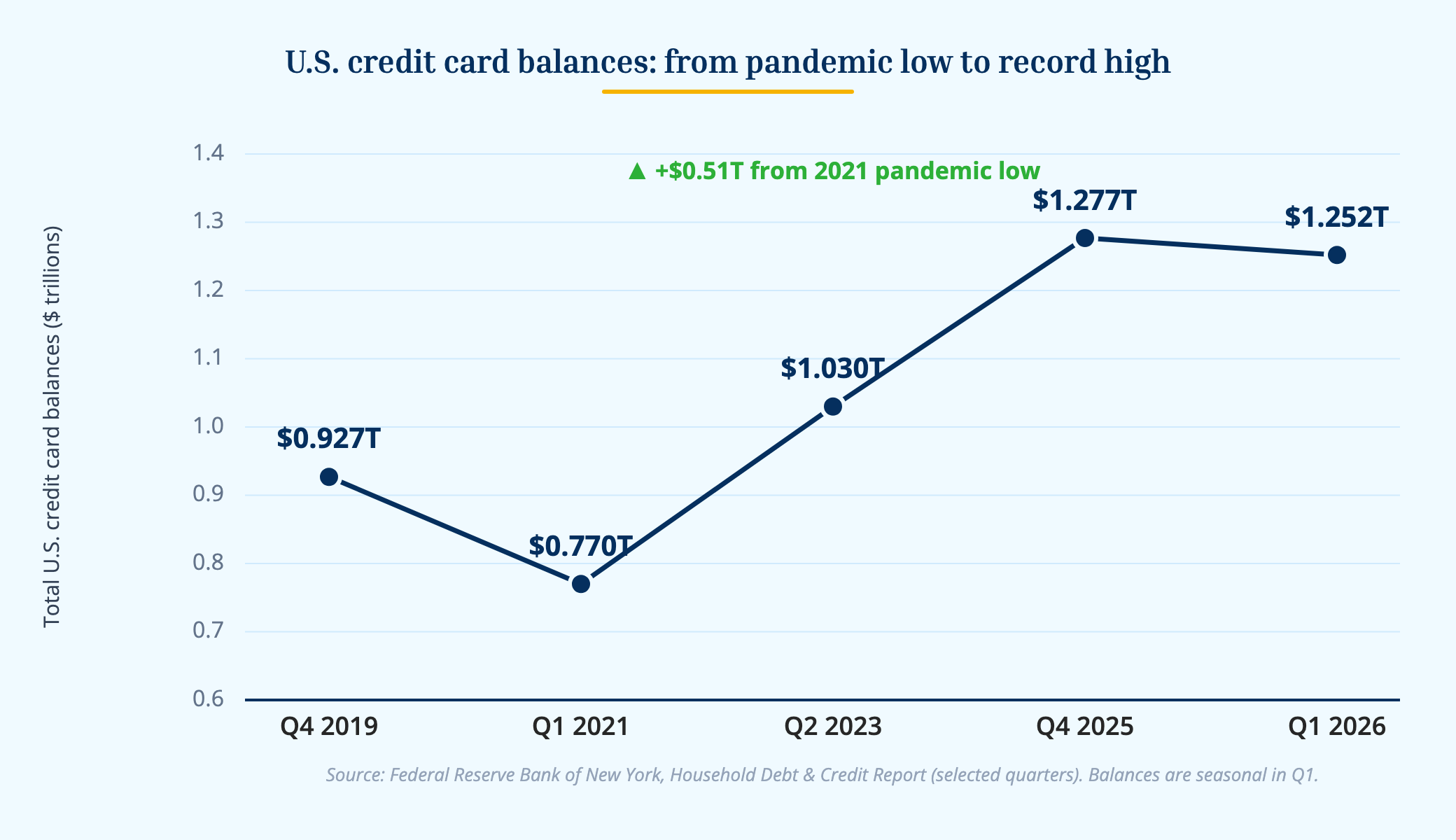
Total U.S. credit card balances, selected quarters. Source: Federal Reserve Bank of New York.
How the pieces fit together
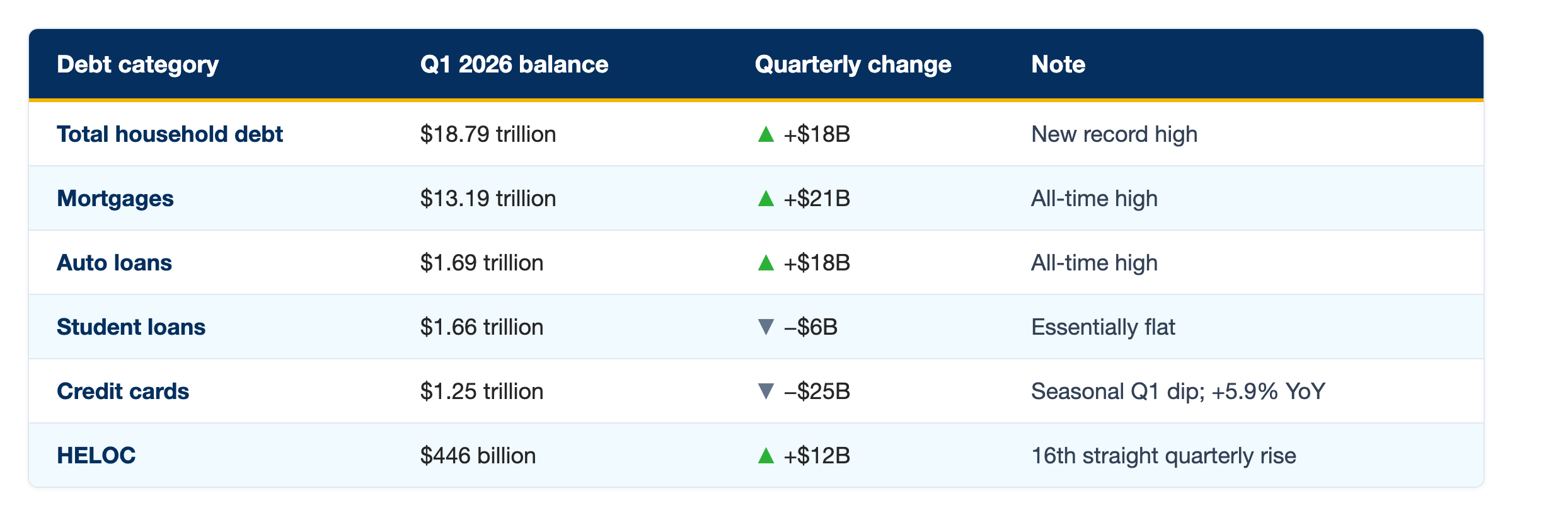
Here's the broader household-debt picture as of the first quarter of 2026, which puts credit cards in perspective against mortgages, auto loans, and other borrowing:
What it means for financial health
The encouraging signal: delinquencies aren't spiraling. The share of credit card balances newly falling behind actually ticked down in early 2026, and the 30-day delinquency rate eased for a seventh straight quarter. Bank of America's own read echoes this — most households remain in reasonable shape on credit availability and savings. But the bank also notes a rising share of customers making only minimum payments, a quieter sign of stress worth watching beneath otherwise steady headlines.
Two lenses, one story: spending is accelerating, balances are near record highs, and most households are — so far — keeping up.
For anyone choosing or managing a credit card, the takeaway is context rather than alarm. Balances are high in absolute terms, but they're being carried by a consumer base that, in aggregate, is still spending and still largely current on payments. Understanding both sides — the spending momentum and the debt load — is the foundation for using credit well.
EXPLORE BANK OF AMERICA ON COMPARECREDIT
→ See Bank of America's current credit card lineup
→ Everyday cash-back and rewards programs
→ Travel and premium card programs
→ Cards for small businesses
Sources
Bank of America Institute, Consumer Checkpoint (January–April 2026 editions) — year-over-year household card spend growth; K-shaped income trends; minimum-payment share. institute.bankofamerica.com.
Federal Reserve Bank of New York, Center for Microeconomic Data, Quarterly Report on Household Debt and Credit, Q1 2026 (released May 2026) — total household debt, credit card balances, delinquency transitions. newyorkfed.org.
Federal Reserve Bank of New York, Household Debt and Credit Report data series (selected historical quarters) — long-run credit card balance figures.
*Note: Bank of America proprietary data reflects the activity of the bank's own customers and is not intended to represent the results of operations or financial condition of Bank of America. This is a sensitive area for some readers — content touching on debt stress should be framed supportively.*